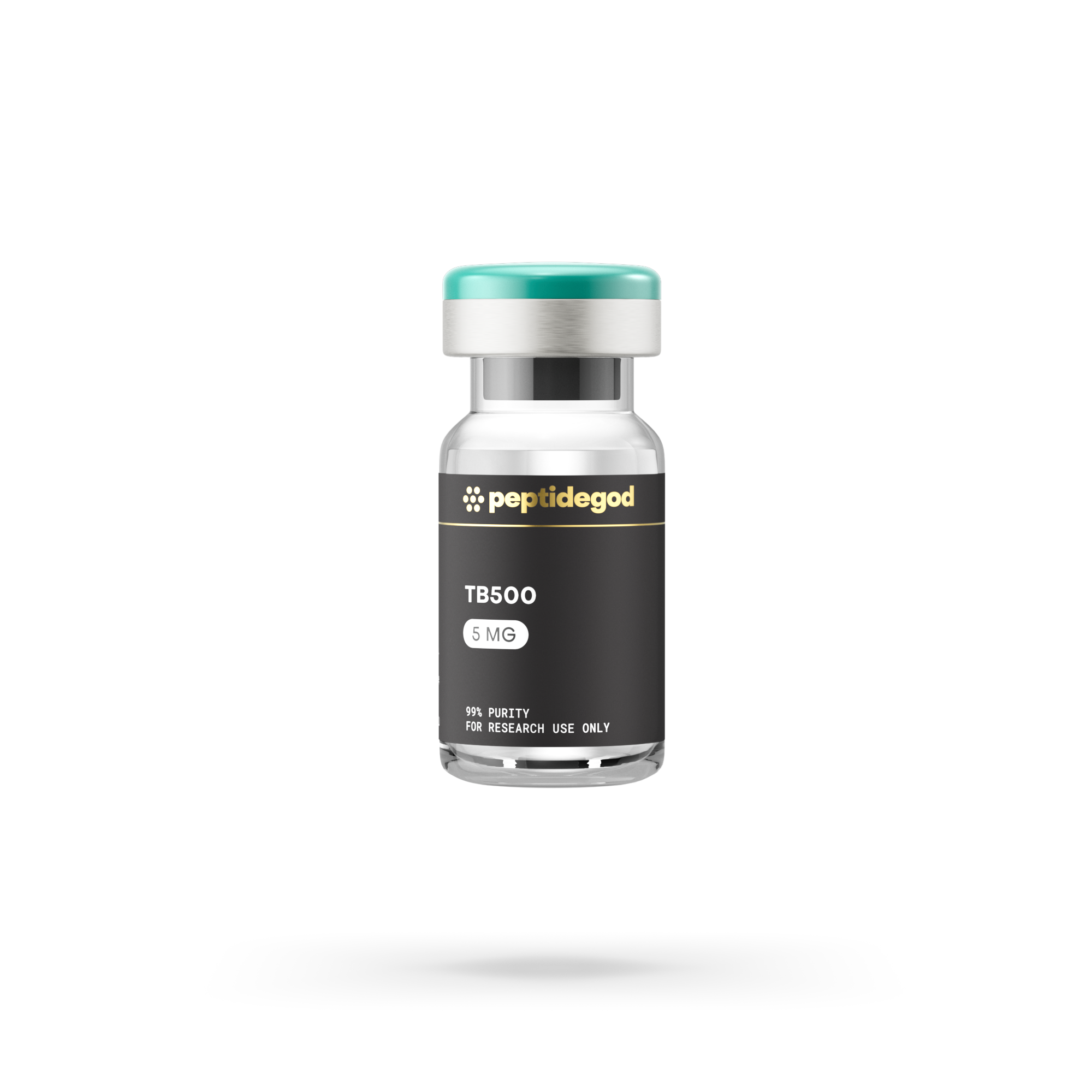
Explore TB500 from Peptide God. View the available size, product details, pricing, and ordering information.
PeptideGod TB500 Review: Pricing and Vendor Terms
PeptideGod TB500 in 5mg ($35.00) and 10mg ($65.00) vials. See price per milligram, store terms and our editorial rating for this thymosin product.
Key Features
- Price: $35.00 (5 mg) / $65.00 (10 mg)
- Per-milligram cost: $7.00 (5 mg) / $6.50 (10 mg)
- Form: Lyophilized powder
- Availability: In stock
- Public COA: Not published
- Stated purity: Not disclosed
- Shipping: Free over $100; ships from Westminster, CA
- Returns: 30-day window
The prices are positioned at the lower end of the US TB-500 market. Suppliers that present an analysis certificate as well as HPLC results for TB-500 usually sell their products for around $40 to $55 per vial. The difference of $5 to $20 is usually due to the presence of analytical documents that can be publicly found.
What's Inside
- Peptide: TB-500 (Thymosin Beta-4 fragment)
- Protein of origin: Thymosin Beta-4, 43 amino acids
- Active region: Actin-binding domain involved in cell motility
- Form: Lyophilized powder requiring reconstitution with bacteriostatic water
In the peptide market, TB-500 and Thymosin Beta-4 are frequently thought to be synonyms, however, they are not one and the same. TB-500 refers to a synthesized peptide fragment, which bears the active chain, while Thymosin Beta-4 indicates the actual protein. In this case, the product page does not show any COA. Also, the listing does not provide HPLC results, endotoxin amounts, or mass spectrometry readings.
- Product
- PeptideGod TB-500
- Sizes
- 5 mg / 10 mg
- Price
- $35.00 / $65.00
- Per mg
- $7.00 / $6.50
- Form
- Lyophilized Powder
- Public COA
- Not published
- Free Shipping
- Orders over $100
- Returns
- 30-day window
- Editor Rating
- 3.7 / 5
| Vial Size | Price | Price per mg | COA |
|---|---|---|---|
| 5 mg | $35.00 | $7.00 | Not published |
| 10 mg | $65.00 | $6.50 | Not published |
How to Store and Handle
To keep sealed bottles in a good condition over a long period of time, their thermal requirements include storage at -20C. The temperature conditions of 2-8C are satisfactory for temporary storage of a few weeks. While lyophilized powder copes with shipping temperatures comfortably, it must be refrigerated or frozen upon arrival.
In order to reconstitute, use an insulin syringe to pull bacteriostatic water out of the vial and into the vial slowly through the wall of the vial. Do not inject directly into the powder cake and do not shake. Let the lyophilized formulation dissolve without interference. Clean the rubber stopper with the alcohol pad before every draw. Store the dissolved solution at 2-8C and use within 28 days. Do not refreeze. For concentration calculations, see our reconstitution calculator.
PeptideGod TB-500 can be found in two different packaging options: a 5 mg vial and a larger 10 mg vial. Their respective prices are $35.00 and $65.00. Both products are shipped from Westminster, California and are currently available in stock. The listing does not provide any information regarding the presence of Certificate of Analysis or any purity testing. We looked at the product in terms of pricing, documentation and policies followed in the selling process.
PeptideGod TB500 Overview
TB-500 is a synthetic peptide fragment of Thymosin Beta-4, a 43-amino-acid protein involved in cell migration, cytoskeletal organization, and tissue repair. Preclinical studies have examined its role in wound healing, cardiac repair, and anti-inflammatory responses in animal models. Human clinical data for TB-500 remains limited.
PeptideGod sells two vial sizes of this peptide. The 5 mg version costs $7.00 per milligram, and the 10 mg vial costs $6.50 per milligram. Both sizes are available and are shipped from US stock. TB-500 is often analyzed with BPC-157 in laboratory investigations. PeptideGod also offers a BPC-157 + TB-500 blend and a standalone BPC-157 product.
Our Verdict
PeptideGod TB-500 earns a 3.7 out of 5. Sub-scores: Testing 3.0, Purity 3.0, Labeling 3.5, Value 4.0. The value score recognizes competitive pricing across both vial sizes and a 30-day return policy that provides some buyer protection. Testing and purity receive the lowest marks because no COA or analytical data is publicly available.
The advantages are the cost as well as the stock level. The sizes are available, the milligram price is less than the average on the market and free delivery starts at $100. The downside is the same for all products from PeptideGod: no analysis certificate, no purity guarantees, and no information about endotoxin testing. Scientists searching for analyzed products can choose suppliers that offer data for every lot. To learn more about the products offered, click on our brands directory. Also, peptideGod sells BPC-157, starting from $34.95 and BPC-157 + TB-500 blend, starting at $59.95.
Our rating
Explore TB500 from Peptide God. View the available size, product details, pricing, and ordering information.
FAQ - PeptideGod TB500
How much does PeptideGod TB500 cost?
The 5 mg vial is $35.00 ($7.00 per milligram) and the 10 mg vial is $65.00 ($6.50 per milligram). The larger size saves $0.50 per milligram. Free shipping applies to orders over $100, so a single 5 mg vial would not qualify on its own.
What sizes of TB500 does PeptideGod sell?
PeptideGod sells TB500 in two sizes: a 5 mg vial and a 10 mg vial. Both are lyophilized powder shipped from Westminster, California. Both sizes are currently in stock.
Does PeptideGod publish a COA for TB500?
No. The product page does not display a Certificate of Analysis, HPLC purity data, or the name of a testing laboratory. Vendors that do publish COAs for TB-500 typically report purity levels of 98% or higher.
Is TB500 the same as BPC-157?
No. TB500 is a synthetic fragment of Thymosin Beta-4, a protein involved in cell migration and tissue repair. BPC-157 is a different peptide derived from human gastric juice protein. The two are often studied together in preclinical protocols. PeptideGod sells them separately and as a pre-mixed blend.